- "Maad" Rants (75)
- "Stuff" No One Ever Told Me About… (24)
- "Stuff" that drives me insane (54)
- American Recovery & Reinvestment Act (26)
- Bookkeeping Tips (211)
- Certified Payroll/Prevailing Wage (1)
- Construction News (76)
- Cool "Stuff" (17)
- FREE QuickBooks eBooks (13)
- Freebie Friday's (27)
- Guest Bloggers (17)
- IRS Information (18)
- Microsoft Office (4)
- New Technology (35)
- QuickBooks Add-Ons (8)
- QuickBooks Corner (265)
- Accounts Payable (14)
- Accounts Receivable (22)
- Free Training (10)
- How To Videos (4)
- Job Costing Tips (33)
- Payroll Tips (72)
- QuickBooks 2011 – What's New? (27)
- QuickBooks 2012 – What's New (6)
- QuickBooks Tips & Tricks (61)
- What's New In QuickBooks 2010 (10)
- Social Media (13)
- The "Sunburst" Website (75)
- Top 10 News from the Web (3)
- Top 10 Tuesday (20)
- Webinars & Training (11)
QuickBooks Productivity Tip – Customizing Lists
The “List” is another basic QuickBooks feature. You will fill out most QuickBooks forms by selecting entries from a list. Lists save you time and help you enter your information consistently and correctly.
QuickBooks Lists are the backbone of the entire process of keeping your books. Each and every transaction that you enter in QuickBooks will work with multiple lists in order to provide you with job costing and accounting functions.
You will find yourself always using these standard lists:
- Chart of Accounts
- Item (Cost Code)
- Fixed Asset
- Price Level
- Billing Rate Level
- Sales Tax Code
- Payroll Item
- Class
- Workers Comp Code
- Other Names
When you select any of these Lists, they display various information, arranged in columns. Did you know that these columns can be customized to display additional information that would be valuable to you and your company?
A good example of customizing information that is displayed in the Chart of Accounts List would be to automatically know, just by looking at the Chart of Accounts, which accounts had been flagged as being 1099 accounts – without having to go into the 1099 Preference and determining which accounts had been selected.
To display a 1099 flag in your Chart of Accounts, you would:
- From the Lists menu
- Choose Chart of Accounts
- Click the Account button at the bottom of the window
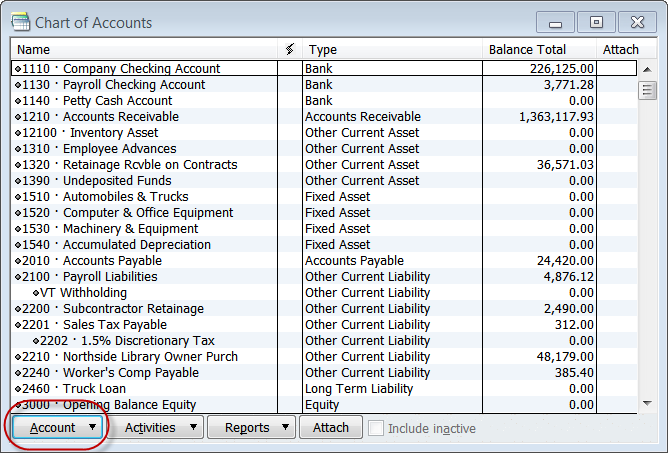
- Choose Customize Columns
- This displays a Customize Columns – Chart of Accounts window which displays a list of Available columns on the left and Chosen columns on the right. Click on the 1099 Account option to select it, then click the Add button.
- The 1099 Account option is now displayed in the Chosen Columns on the right. Click Ok to save your changes.
- Now, when you display your Chart of Accounts List, any accounts that have been selected for 1099 reporting will be flagged and display the type of 1099 required.
Customizing the columns displayed in the Chart of Accounts listing to display 1099 flag provides a productivity boost all year long – not just at year end.
Go ahead and experiment with the information displayed in various lists by selecting available columns on the left and adding them to chosen columns on the right.
Simple customization such as this will help you get more done in less time – because you don’t have to constantly search for information.
Related Posts
- QuickBooks Productivity Tip – Use the Open Window List
- QuickBooks Tip – Merging Duplicate Items and/or Accounts
- QuickBooks Tip – Modifying & Working with your QuickBooks Chart of Accounts
- QuickBooks Tip – The Chart of Accounts, What It Is & It’s Many Uses In Your Business
- QuickBooks Tip – Construction Accounts Payable
- Bookkeeping/Accounting Tasks and Employee New Hire Packet
- QuickBooks Tip – An Audit Trail for Accounts Receivable
- QuickBooks Tip – Easy Access to Employee Payroll Forms
- QuickBooks for Contractors Tip – Receiving & Applying Joint Checks
- QuickBooks Tip – File Size & DB File Fragments What Do They Mean?
2 Responses to QuickBooks Productivity Tip – Customizing Lists
Leave a Reply Cancel reply
- Using Account Numbers in Your QuickBooks Chart of Accounts
- Straight from the IRS - Social Security Tax Reduced to 4.2%
- Calculating & Displaying Fringe Benefits on a Certified Payroll Report
- Frequently Asked Questions - California Prevailing Wage
- QuickBooks 2011 - Computer Requirements & Office Compatibility
- QuickBooks 2011 - 10 Tips for a Successful Installation/Upgrade
- U. S. Department of Labor Revises Certified Payroll Reporting Requirements for Form WH-347
- QuickBooks 2012 Announced
- New FHWA-1391 & 1392 Annual EEO Forms For Highway Contractors
- QuickBooks 2012 - Frequently Asked Questions About Upgrading

- Top 10 Thursday – News from around the Web 2/2/12
- Certified Payroll Reports & Bi-Weekly Paychecks
- Choosing QuickBooks & Add-Ons for Your Construction Business
- Paycheck/Payroll Frequencies by State
- Inbound Marketing
- Top 10 Thursday – News from around the Web 1/26/2012
- Bookkeeping/Accounting Tasks and Employee New Hire Packet
- Working With Taxable & Non-taxable Items and Customers
- eBook – Have You Built Your Google+ Business Page Yet?
- Top 10 Thursday – News from around the Web 1/19/2012
- Bookkeepers Test & Hiring a Bookkeeper or CPA
- QuickBooks Weekly Timesheet – Service vs. Payroll Item
- Free eBook: An Introduction to Lead Generation
- Top 10 Thursday – News From Around the Web 1/12/12
- Our Blog in 2011 – The Year in Review
- February 2012 (2)
- January 2012 (19)
- December 2011 (4)
- November 2011 (4)
- October 2011 (8)
- September 2011 (14)
- August 2011 (11)
- July 2011 (12)
- June 2011 (21)
- May 2011 (16)
- April 2011 (11)
- March 2011 (21)
- February 2011 (20)
- January 2011 (13)
- December 2010 (11)
- November 2010 (17)
- October 2010 (10)
- September 2010 (17)
- August 2010 (10)
- July 2010 (17)
- June 2010 (17)
- May 2010 (14)
- April 2010 (21)
- January 2010 (3)
- October 2009 (5)
- September 2009 (9)
- August 2009 (3)
- July 2009 (2)
- June 2009 (2)
- May 2009 (2)
- April 2009 (4)
- March 2009 (8)
- February 2009 (9)
- January 2009 (8)
- December 2008 (13)


Thanks Laura. Tracking 1099′s is such a pain!
This is a great idea!!
I use the customize columns to add that column to the vendor list, but never thought to use it on the Chart of accounts.
Thanks for sharing!!
Laura D